Category Archives: Employment & Productivity

Deportations are not Helping Immigrants

Last summer, we wrote up the work of Ben Zipperer, who found that, based on past deportation episodes, the current and much larger episode is likely to result in substantial job losses for native-born workers as well. That seems to be happening already, though it’s likely we’re only in the early phases of what could be a major shock.

The numbers look quite large. Quoting ourselves citing Zipperer: “[O]ver the next four years, 3.3 million jobs held by immigrants will disappear, plus another 2.6 million held by native-born, for a total of 5.9 million—almost 4% of total employment. In other words, for every 1,000 immigrants who lose their jobs, almost 800 natives will as well.”

Read more: Deportations are not Helping Immigrants

The reason is that occupations dominated by natives and immigrants are complementary, not rivalrous. For example, in the construction industry, immigrants dominate less-skilled roles and natives the more-skilled ones. As Zipperer puts it, “when there are fewer immigrant roofers and framers to build the basic structure of homes, there will be less work available for U.S.-born electricians and plumbers.” Early signs on that score are not encouraging: for the year ending in March 2026, employment in residential construction, where roofers and framers work, was down 0.4%; in specialty trades, where electricians and plumbers toil, it was down 1.1%. 

We’re seeing evidence that native and immigrant employment are moving in tandem, not opposition, in recent aggregate data as well. In an April 3 blog post for the Economic Policy Institute, Zipperer noted rising unemployment rates for native-born workers. We’re extending that work some.

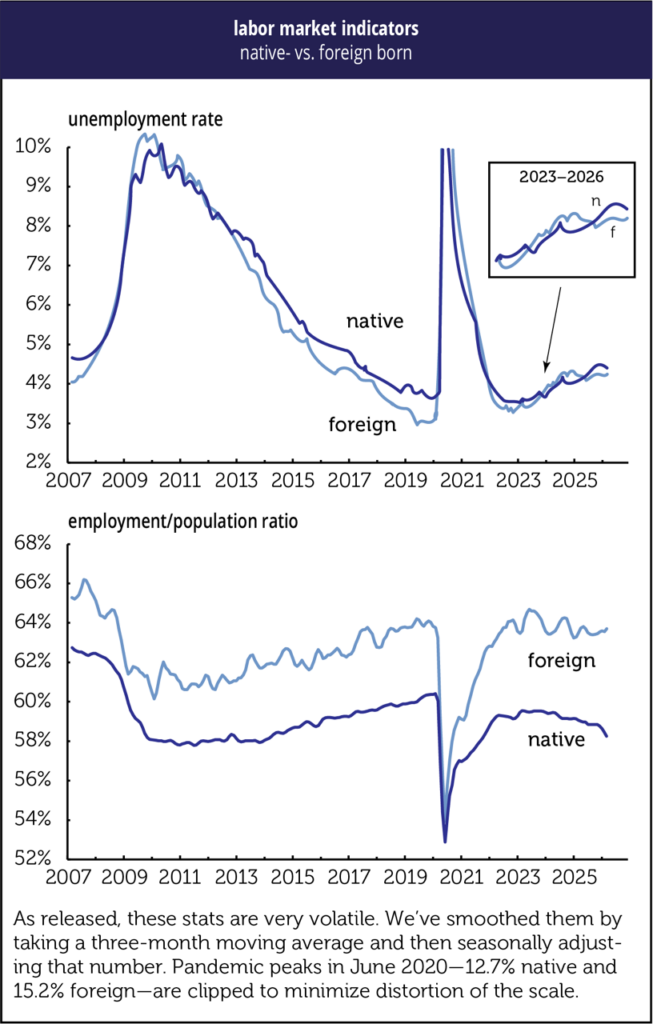
Household stats based on nativity are very volatile from month to month. To compensate for that, Zipperer used three-month moving averages and then seasonally adjusted them. He looked only at native-born unemployment rates since 2023. We made the same adjustments on the unemployment rate and the employment/population ratio (EPOP). The results are graphed below.

A couple of points. Since 2012, the unemployment rate for foreign-born has almost always been lower than that for natives. The major exception: the worst months of the pandemic in 2020 and 2021, as workers in immigrant-heavy sectors like leisure and hospitality were laid off with particular intensity. Over the last couple of  years, the rates have moved in near-lockstep, with the native slightly higher.

Things are a little different for the EPOP. For the entire period since 2007, the immigrants’ ratios have always been higher than natives’, and by a fairly consistent margin. (Since 2007, the ratio of foreign to native EPOPs has averaged 126%; the maximum is 129% and the minimum, 120%.) Since peaking in July 2023, the fully averaged/adjusted EPOP for immigrants down 0.9 points, and 1.2 for natives. Since December 2025, the last full month before the deportation machinery was cranked up—which happened right after Trump took office—the immigrant EPOP is up 0.2 and the native is down0.9.

Employment figures are also negative. For the three months ending in March 2026, native employment is down 0.2% from the three months ending in March 2025; for immigrants, it’s down 1.0%. There’s a stark gender contrast: male immigrant employment is off 4.5%; women, up 3.5%. For native males, employment is down 0.6%; for women, up 0.3%.

As we noted, these numbers are noisy. And given fear and dislocation, getting survey responses from immigrant workers is probably more difficult than ever. So we take these stats as preliminary, and more suggestive than definitive. But what they suggest is that immigrants’ losses are not natives’ gains. There are losses all around.

The 2024 Benchmark in a 32-year Frame

As you can see on the graph below, the 2024 benchmark, -0.5%, is the fifth largest over the last 32 years, among 2009’s -0.7%, 1994’s +0.7%, 2006’s +0.6%, and 1995’s +0.5%. It’s reassuring they aren’t all in the same direction. The annual benchmark is an integral part of the BLS process, and a major reason the establishment series is so important.
Between 1993 and 2000, revisions averaged 0.3% in absolute terms, narrowing to 0.2% between 2001 and 2019, including 0.2% between 2001 and 2008, and 0.1% between 2010 and 2019. Since 2020, the average moved back up to 0.3%, not so surprising given the displacements of the pandemic.
In our experience, the employees at the Bureau of Labor Statistics take questions seriously. We all have many questions, sometimes presented as theories and even facts, about how demographic groups may be affecting differences between the establishment and household surveys, the Quarterly Census of Employment and Wages, and hence the benchmark itself. We all can address those open questions to the staff at BLS. They will look into our questions, and in time they will answer them. And they may turn up methodological issues they can clarify or improve in the process.

2023Q2 Hard Employment Data Confirms BLS Estimates

There’s been a lot of controversy about the accuracy of the Bureau of Labor Statistics’ recent job projections, but hard employment data from the Quarterly Census of Employment and Earnings released this morning show employment rose over the year in 2023’s second quarter by 2.4%, exactly what the QCEW’s sibling, the Current Employment Statistics, CES, or Establishment Survey is showing. As we know, the QCEW and the CES had been trading places for a few quarters. In the first quarter, the CES was ahead of the QCEW, resulting in the negative annual benchmark, -0.2% overall, and -0.3% private, announced in August.

Average weekly wages, which are notoriously not comparable to average hourly earnings, were up 3.2% year over year, compared to 4.4% gain currently estimated in the Establishment Survey. The QCEW includes many extras in the wage number, and may indicate how much better those with full benefit packages are doing than are those without. That difference may be in line with what we’ve been seeing for some time in the average hourly numbers: production workers have been seeing larger wage gains than have their supervisors.

Nationally, strongest wage gains were reported among natural resources & mining, 6.0%, and construction, 5.6%; weakest gains in financial activities, 2.1%. In half of the ten largest counties weekly wages in finance slipped over the year.

Midland, Texas reported the largest employment increase, 7%, led by a 12% increase in natural resources & mining; Elkhart, Indiana the largest decrease, -7.7%, driven by a 14% decline in manufacturing.

A 24% increase in trade, transportation and utilities wages lifted wages in Clayton, Georgia by 17%, while a 17% loss in earnings in manufacturing drove wages in Elkhart down by 13%. Elkhart has tended to lead national manufacturing over the years.

Jobs rose over the year in all states, with growth ranging from California’s 0.9% to to 3.6% in noisy Alaska, and 3.7% in Florida, 3.8% in New Mexico, and 3.9% in Texas. Alaska, New Mexico and Texas all have large resource extraction operations.

Largest wage gains included 6.1% in West Virginia, 6.5% in New Mexico, and 4.9% in North Dakota, 4.8% in Colorado, and 4.6% in Wyoming, all states with large extraction sectors. Those last three are the only states where wage growth rounds up to five, with growth in Indiana and Pennsylvania lagging at 2.0%, Maryland and Minnesota at 2.2%, and wages actually down over the year in Rhode Island.


Non-Productive Poaching: It’s a Thing

Hat tip to Josh Lehner, of the Oregon Office of Economic Analysis, for suggesting we look at The Dual Beveridge Curve by Anton Cheremukhin and Paulina Restrepo-Echavarría, of the Dallas and St Louis Feds.

We’re outlining their research here, and strongly recommend you look at the graphs if you don’t have time to read through the paper. We were planning to take up a few other papers on the Great 3-Rs Debate—Resignation, Retirement and now Renegotiation—in this issue, but we’ll leave that for later to focus on this paper. It presents a very different way of considering the Beveridge Curve. To us it’s a real relief to have creative researchers getting into this instead of shrugging it off as a mystery, or building inaccurate narratives.

Some ads are looking for workers from the pool of the unemployed, others aim to poach employees. The two objectives target different skill sets, and have different effects on the labor market: a job shift has no effect on un- and employment rates, but a hire from the pool of unemployed workers does.

When the authors first call their view “extreme,” we thought, hey, it actually could just as easily be called highly logical. The extreme comes in because their “simple” model breaks the overall search and matching process into two non-overlapping processes: the two sets work in “separate, segmented” markets.

This departs from the usual practice that aggregates all workers, the employed and the unemployed, who may be searching for a job, with all vacancies, adds something new to the literature, and also contributes to the measurement of the searches of the employed.

In their underlying remarks they note that 99% of the unemployed spend some time actively looking for work, which is in line with the Bureau of Labor Statistics’ definition of being unemployed and with survey results, but that a far smaller share of the employed search for work. Using the Survey of Consumer Expectations and work by Jason Faberman they put that at about 22%. The employed are more efficient than the unemployed at finding work.

In their words, a “proper” Beveridge Curve should only include ads aimed at the unemployed. To do this, they break the Beveridge Curve out by sector, creating adjusted curves, which take the mystery out of the curve’s behavior. If you exclude the poaching ads, you end up with a very ordinary curve. (Please note they used the Household Survey adjusted to be like the Payroll Survey for this, not that other noisy thing.)

We snapped their graph (below), and you can see that the increase in poaching ads increased significantly in 2015. In their words, the curve shifted up at that time because of “a dramatic increase in non-productive poaching vacancies.” (We’ll say dramatic. That graph is as stunning as the openings rate was unbelievable to us.)

There was some drama in the most recent recession. Poaching vacancies dropped in 2020 and quickly recovered, but vacancies fishing for the unemployed rose in the recession, a time of social distancing, high unemployment, and decreased poaching. Spurred by measures to control the pandemic, more workers were laid off than could be explained by the fall in demand, and many were hired back quickly.

At this point, fiscal and monetary policy drove up demand, firms needed to expand, and that poaching reaccelerated. Supply bottlenecks and demand led to a surge in goods inflation, and poaching drove up wages. That’s what happened recently, and Cheremukhin and Restrepo-Echavarría are searching micro data to understand what drove the poaching surge in 2015.

Considering what will happen to unemployment, they note that in the 2000s ads designed to poach and those designed to draw were about the same, but now the majority of job openings target the employed. That would suggest the decline in openings might have an historically small effect on unemployment, and here they mention a soft landing.

But they add a caution. If mismeasurement is improving, then the Beveridge curve has shifted outwards, but the slope has not changed, and we don’t have the steepened curve required for the soft landing. Then a decrease in vacancies could drive an increase in the unemployment rate.

They also reference work done in 2013 showing that as of 2011, 42% of hires came from firms that did not report any openings. Alas, wider knowledge of that study might have saved us a lot of time spent squabbling over the openings rate.

Coda: Back in 2015, just as the yet-to-be-explained surge in poaching got underway we renamed, and in print, the openings rate the “Tire Kicker Rate,” on the belief that employers were just fishing, and raised many red flags that the openings rate was not doing well as an indicator, and it was likely driving faulty policy.

And that’s the sobering fact in this paper: The narrative was that unemployed workers were either too unskilled or too lazy to work. All the hullabaloo about job openings and the unemployed was misdirected. The companies were angling for workers already employed elsewhere, and the unemployed took the rap.
State university systems or collapsing bridges? Our choice

It’s been a while since we looked at net investment in the US, and we weren’t surprised to learn that the basic story hasn’t changed. Private investment is only a bit ahead of depreciation, and public investment even less so. So far in 2022, net fixed investment by the private sector has been 2.1% of GDP, which is also its average so far for the decade. As the graph on below shows, that’s about half what it was from the 1960s through the 1980s and is only slightly above what it was in the 1940s, the decade when civilian investment was squeezed to supply war needs:

Low levels of net private investment aren’t driven by declines in gross investment, which has been pretty stable. Instead, the major reasons for the decline are a shift towards shorter-lived equipment and the immateriality of intellectual property (IP) and a shift away from buildings. From 1950–1999, net fixed private investment averaged 32% of gross; since 2000, it’s averaged 20%—and 16% since 2020. Every asset category has seen that shift. Net equipment investment went from 24% of gross from 1950–1999 to 15% since 2020. Even nonresidential structures aren’t being built for the ages; they went from 49% of gross to 16%. (Are they just building self-storage units these days?) And IP isn’t what it used to be either; its net went from 23% of gross in the earlier period to 16% in the most recent.

Residential net investment isn’t doing too great either: it went from an average of 2.8% of GDP from 1950 to 1999 to 1.7% in the 2020s. Unlike the mid-2000s housing bubble, which took net residential investment up to 3.8%, the highest since the post-World War II decade, the latest bubble took net housing investment up to just 1.9% of GDP last year. It’s fallen back to 1.4% in 2022. That’s not the way to meet a housing deficit estimated by Freddie Mac at 3.8 million units.

For the public sector, the decline in net investment has been more dramatic, falling from around 2% of GDP in the early decades on the graph to 0.4% since 2020. (It’s 0.3% so far in 2022.) Like the private sector, we’ve seen a shift towards shorter-lived assets, but unlike the private sector, we’ve also seen a decline in gross investment, which fell by almost half between the 1960s and 2020s. Net federal civilian investment is just 0.1% of GDP so far this decade, a third its 1950–1999 average. State and local investment has fallen harder, down by almost three quarters from that 50-year average to 0.5% in the 2020s (0.3% so far this year).

The graphs below give a yearly view since 1950. They tell the same story: steady decline, with cyclical oscillations around the trend. The burst of net private investment in the late 1990s gave us a major productivity acceleration, but it was not to last. And the burst in civilian public investment from the early 1950s through the late 1960s gave us interstate highways, schools, and state university systems. The long declines in net investment, both private and public, have given us stagnant productivity growth and a collapsing infrastructure.